Record-breaking heatwaves, prolonged droughts, and growing water scarcity are reshaping water resource management across Europe. For water utilities, digitalization is no longer a vision of the future it has become an essential tool for ensuring reliable and sustainable water supply.
On July 2, 2026, the city of Munich declared a state of emergency due to water shortages. Prolonged drought, record-high temperatures, and declining groundwater levels placed unprecedented pressure on the city’s water supply system. According to local authorities, the region had not experienced a situation of this scale since the early 1970s.
Munich, however, is only one example. Similar challenges have already affected Osnabrück, Hamburg, Mainz, and other regions across Germany, where residents have been urged to reduce water consumption. Extreme heatwaves have also spread across France, Belgium, and the Netherlands, once again demonstrating that water stress has become a Europe-wide challenge.
Climate change is driving utilities to move beyond traditional water metering toward the digital management of entire water distribution networks. Modern technologies enable real-time data collection, rapid leak detection, predictive maintenance, and more efficient allocation of water resources.
Today, the digital transformation of the water sector is being driven by several key factors.
Droughts and extreme heat are placing increasing pressure on available water resources. In Southern European countries such as Italy, Portugal, Greece, and Cyprus, smart metering systems are already regarded as one of the key tools for managing water demand and improving resource efficiency.
According to the European Environment Agency, approximately 25% of the water supplied through distribution networks across the European Union is lost due to leaks.
Without digital monitoring, these losses often remain undetected until significant volumes of water have already been wasted. Smart water meters make it possible to identify abnormal consumption patterns and hidden leaks almost immediately after they occur, enabling utilities to significantly reduce non-revenue water and improve operational efficiency.
European digitalization policies are providing an additional incentive for utilities to modernize their infrastructure.
Beginning in 2026, the EU Action Plan for the Digitalization of the Water Sector promotes broader deployment of interoperable digital platforms, real-time monitoring, advanced data analytics, and artificial intelligence technologies throughout the water industry.
According to the European Commission, smart metering technologies can reduce water consumption by up to 25%, while digital water management systems further improve the operational efficiency of water distribution networks.
The practical experience of European water utilities demonstrates that digital technologies are already delivering measurable results.
Studies show that facilities equipped with smart water meters and remote monitoring systems can reduce water consumption by up to 25%, while simultaneously lowering network maintenance costs and significantly reducing the time required to detect and respond to leaks and other failures.
The smart water meter becomes part of the digital infrastructure
The water industry is steadily moving beyond the concept of a conventional metering device toward a new model in which the water meter serves as an intelligent sensor within a digital ecosystem.
Today, a smart water meter provides valuable insights into the condition of the entire distribution network. It helps detect leaks, identify abnormal consumption patterns, monitor system performance, and supply the data needed to build digital models of water infrastructure.
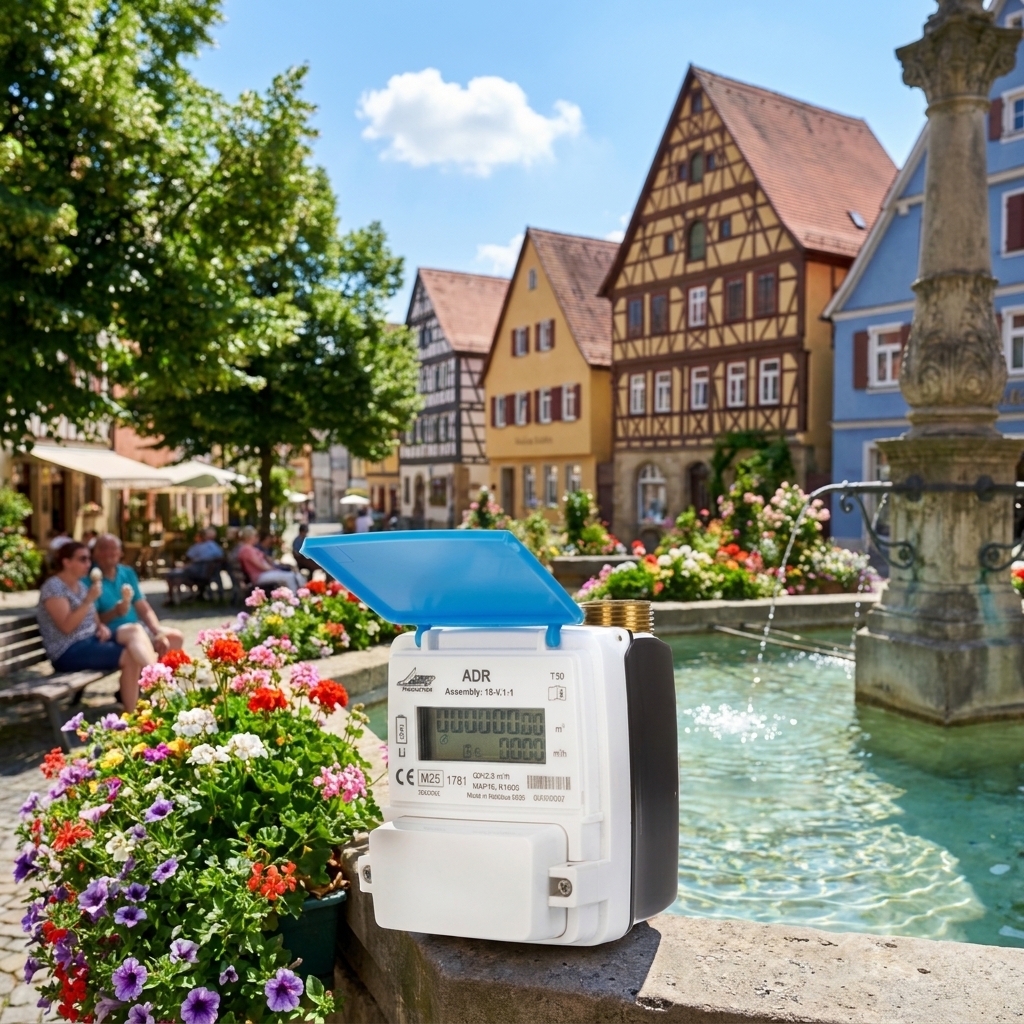
The ADDRA ultrasonic water meter has been designed to meet these evolving industry requirements.
Using ultrasonic measurement technology, high-precision detection of even the smallest water flows, and support for modern communication technologies including NB-IoT, LoRaWAN, Wireless M-Bus, and MIOTY ADDRA provides continuous real-time data collection. This enables utilities to detect leaks more quickly, access meter readings remotely, improve network efficiency, and make informed decisions based on accurate, up-to-date information.
Digitalization is becoming the industry standard
The European smart water management market continues to grow rapidly. According to market analysts, its value is projected to increase from USD 6.4 billion in 2026 to USD 13.3 billion by 2034.
For water utilities, digitalization is no longer simply a long-term investment in innovation. In the face of climate change, increasing pressure on aging infrastructure, and growing resilience requirements for critical services, intelligent metering systems have become one of the key tools for conserving water resources and ensuring a reliable water supply.
ADDRA helps water utilities move beyond basic consumption measurement toward intelligent water resource management by providing greater data transparency, early problem detection, and improved operational efficiency across the entire water distribution network.
For more information, please contact us at info@addgrup.com


