Palestine’s water sector continues to face serious challenges: limited natural resources, deteriorating distribution networks, and high levels of non-revenue water are placing pressure on operators and directly affecting the stability of water supply to the population. Even minor, persistent leaks at the end-user level can amount to tens of thousands of liters of lost water per year, generating significant financial losses and reducing overall system efficiency.
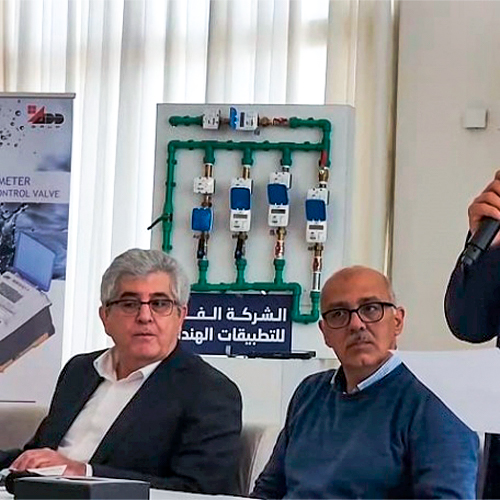
In this context, the Federation of Water Service Providers in Palestine, in partnership with the Technical Company for Engineering Applications (TCEE), organized a specialized workshop titled “Smart Water Facilities in Palestine: Strategies, Technologies, and Lessons Learned.” The event brought together representatives from government bodies, international institutions, municipal councils, and water service providers to discuss pathways for the sector’s digital transformation and the adoption of smart solutions.
The workshop was opened by Engineer Ali Odeh, Executive Director of the Federation, who emphasized the strategic role of smart technologies and operational digitalization in improving the efficiency of water facilities, reducing losses, and optimizing operational costs. He noted that digitalization not only strengthens infrastructure resilience but also reinforces water security for citizens — particularly in light of the current political and economic challenges.
Engineer Munther Jubran, President of TCEE, presented the advanced technological solutions showcased at the accompanying exhibition and demonstrated their role in the development of monitoring and management systems. He highlighted that integrating smart metering devices and analytical platforms makes it possible not only to optimize operations and maintenance, but also to apply international best practices in resource management.
One of the key solutions discussed at the workshop was the ADDRA ultrasonic water meter by ADD GRUP. Its defining feature is high measurement accuracy even at minimal flow rates starting from 1 liter per hour, enabling the detection of small, persistent leaks that mechanical meters often fail to register. The absence of moving parts ensures long-term measurement stability, while remote monitoring capabilities via NB-IoT, LoRa, or WM-BUS allow issues to be identified at an early stage, minimizing both physical and commercial losses.
Throughout the workshop, participants shared their experiences, discussed current challenges, and collaboratively developed ideas for improving sector efficiency. Practical scenarios were examined, illustrating how precise digital metering and intelligent management systems can reduce non-revenue water levels, improve billing transparency, and enhance long-term infrastructure sustainability.
The workshop confirmed that for Palestine, digitalization and the adoption of smart metering are no longer merely innovative tools — they represent a strategic necessity. Solutions such as the ADDRA ultrasonic water meter enable operators to shift from reactive leak response to proactive management, improving efficiency, transparency, and the sustainability of water supply under conditions of limited resources.
For more information, please contact us at info@addgrup.com
Official news source: https://www.maannews.net/news/2156843.html


