
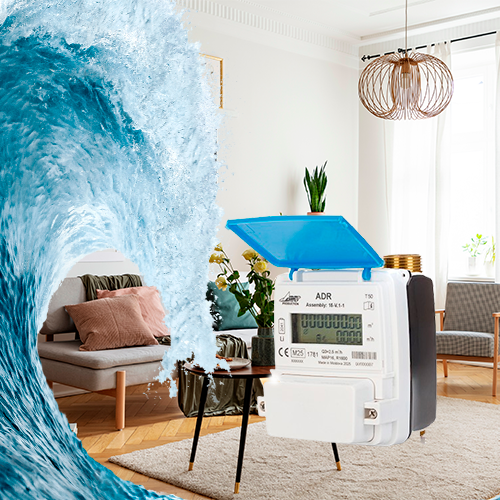
How a smart water meter with leak protection changes the rules of the game
Imagine this: you are on vacation, on the beach, with a cocktail in your hand. Meanwhile, at home, the hose of your washing machine bursts. Water floods the floor, seeps to the neighbors, damages parquet flooring, furniture, and electrical systems. The damage amounts to tens of thousands of euros. By the time you return, the apartment requires major renovation. This is not rare. In Germany, insurance companies annually pay billions of euros for water damage cases — so-called Leitungswasserschäden. Water damage is one of the most common causes of property insurance payouts, alongside fires and storms. At the same time, most accidents could have been prevented if the water had been shut off in the first minutes.
This is exactly the problem solved by a new generation of smart water meters — meters with a built-in valve and leak protection system.
What is it?
Externally, it is a regular ultrasonic water meter installed at the water inlet of an apartment or house — instead of an old mechanical meter. But inside, it is a completely different system. In addition to precise measurement of water consumption, the housing contains a pressure sensor, a built-in electric valve, and a microprocessor with a set of algorithms that continuously analyze the condition of the water supply network.
The meter is connected to a mobile network (NB-IoT or LoRaWAN) and transmits data to the cloud. You can see water consumption, pressure, and temperature in a mobile application. But most importantly — in the event of an emergency, the meter independently shuts off the water within seconds, even before you learn about the problem.
How does it detect a leak?
The system uses five levels of protection — from instant burst detection to identifying micro-leaks invisible to the naked eye.
Why is it better than a separate valve?
There are separate leak protection systems on the market — floor-mounted sensors, motorized valves. But the integrated solution has fundamental advantages.
Who needs it?
Anyone who does not want to one day discover their apartment flooded. But especially property owners who rent out or do not permanently live in their properties: country houses, apartments, commercial premises. It is vacant properties that suffer most from leaks — water can flow for hours or even days until someone notices.
For utilities — it is a tool to reduce water losses in the network. For insurance companies — a way to reduce payouts: some insurers already offer a 5–10% discount on a policy when such a meter is installed.
Conclusion
A water meter with leak protection is not a futuristic idea, but a ready technology. Ultrasonic flow measurement, built-in pressure sensor, electric valve, accident detection algorithms, and mobile communication — all this already exists in one compact housing the size of a regular household meter. You know exactly how much water you consume, see the pressure in the network, receive anomaly notifications — and can calmly go on vacation knowing that in case of an accident, the water will be shut off automatically. Sometimes the best technology is the one that works unnoticed. Until the moment it saves your apartment.
For more information, contact us at info@addgrup.com


