Modern requirements for water metering accuracy and resource management are changing the very role of the water meter. If previously it performed a purely measuring function, today it has become a full-fledged element of the digital water supply infrastructure. This transformation is the result of a long-term evolution of water metering technologies.
Measurement Technology
The first water meters were entirely mechanical. Their operation was based on the rotation of an impeller or turbine driven by the water flow. Simple design and the absence of electronics made such devices an industry standard for decades. Utilities valued them for their reliability and ability to operate without intervention for 8–10 years. Over time, however, the limitations of mechanical solutions became evident: wear of moving parts, decreasing accuracy, high sensitivity to contaminated water, and the inability to measure minimal flows, including leaks.
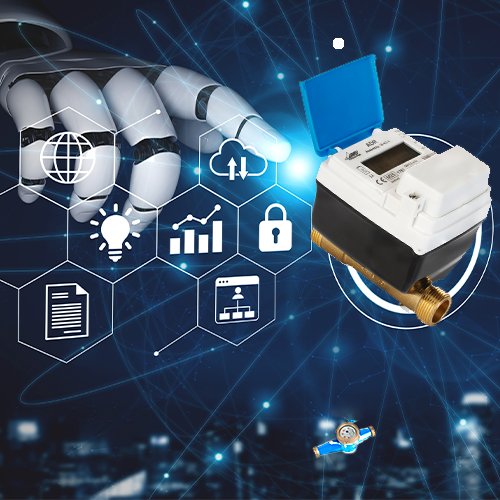
A fundamental shift occurred with the introduction of ultrasonic water meters. Unlike mechanical meters, they have no moving parts and measure water flow using ultrasonic signals. This principle ensures consistently high accuracy throughout the entire service life, reliable operation even with contaminated water, and the ability to measure very low flows starting from 1 liter per hour. From this point on, the water meter ceased to be aware-prone device and became a digital measuring instrument.
Communications
The next stage of development was the emergence of AMR (Automated Meter Reading) systems. This marked the first step toward digitalization: meters gained the ability to automatically transmit readings, reducing the cost of manual data collection. However, AMR remained a one-way system it enabled remote reading but did not allow control over water supply or rapid response to network events.
The evolution of communication technologies led to the formation of AMI (Advanced Metering Infrastructure) a two-way system that not only collects data but also enables device management within the network. Combined with an integrated valve, an ultrasonic meter becomes an active infrastructure element: it allows remote limitation or shut-off of water supply, management of debt and prepayment, and rapid response to leaks and emergency situations.
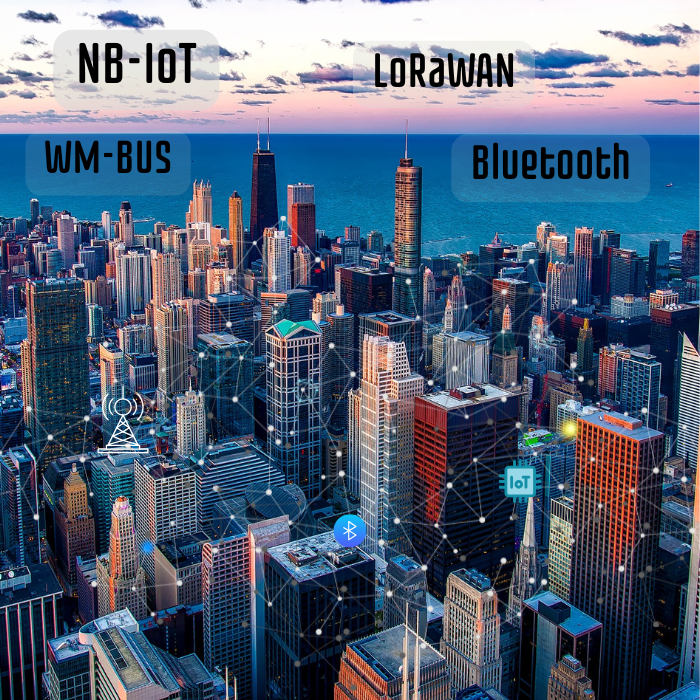
Since none of the communication channels used for water meters can guarantee stable connectivity and coverage, utilities in many cases require a backup communication channel, such as WM-Bus, which periodically broadcasts messages for drive-by/walk-by systems. However, even this one-way channel is not the limit. Solutions are emerging that support multi-RAT technology, including NB-IoT, LoRaWAN, mioty, and WM-Bus within a single meter, enabling dynamic switching to the most optimal communication channel directly in the field.
In modern AMI systems, where technology must also serve cost optimization, a master meter solution plays a key role. This central device aggregates data from multiple subordinate meters installed, for example, in apartment buildings, neighborhoods, or network distribution points. A multi-RAT-enabled master meter provides centralized data collection via BLE from connected water meters, synchronization of readings and events, transmission of information to cloud platforms, and coordination of valve control and events across the entire network. As a result, the master meter creates a unified digital metering profile for large water supply sections, improves water balance accuracy, and provides utilities with transparent and comprehensive insight into water consumption at all system levels while significantly reducing equipment and communication costs.
Service Life
The transition to intelligent systems is accompanied by natural concerns from utilities, primarily related to battery life. Mechanical meters require no power supply, creating a perception of a “permanent” device, whereas ultrasonic meters are limited by battery capacity. However, modern solutions employ optimized power management systems, including built-in and replaceable high-capacity batteries, enabling a service life of up to 30 years. Essentially, the battery becomes a managed energy resource a conscious trade-off in exchange for accuracy, control, and analytics.
What ADD GRUP offers
Modern ADD GRUP solutions feature high climatic resistance (from –25 °C to +70 °C), IP68 protection, an integrated valve for remote water supply control, and a combined power system with a battery capacity exceeding 20,000 mAh. In addition to measuring consumption, these meters detect leak events, reverse flow, tampering attempts, and generate a detailed real-time consumption profile. Additional sensors, including accelerometers, significantly expand the device’s functionality beyond traditional metering.
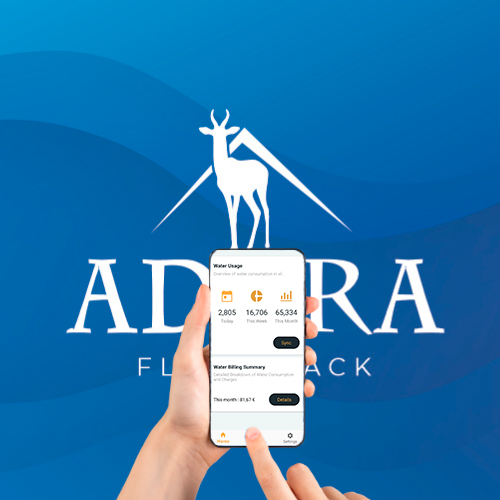
The availability of multi-RAT and BLE interfaces enables flexible communication scenarios, as well as connection of an external valve and smartphone interaction for both utilities and consumers.
In 2025, ADD GRUP introduced a new stage in intelligent water metering development an ultrasonic meter with an external power bank module. Contrary to the common perception of high costs, the replaceable power bank is an affordable component costing approximately €3, while offering a long service life. This solution addresses key concerns related to meter replacement due to battery depletion and allows the device’s operational life to be extended without dismantling or reinstallation.
The history of water meter development shows that every technological transition is initially met with resistance but ultimately becomes an industry standard. Today, ultrasonic meters with AMI functionality and integrated valves are not merely the next evolutionary step—they form the foundation for accurate, manageable, and sustainable water supply systems capable of meeting the challenges of a digital future.
We invite you to visit our stand to see these solutions in action and discuss their application in your projects. At ESSEN Germany 2026, you will be able to explore the benefits of the updated ADDRA series and learn how the new master meter architecture optimizes metering and improves water management efficiency.
ESSEN, Germany – February 10–12, 2026, Stand No. 2E144
To arrange a meeting or register at the ADDGRUP stand, please contact us at: info@addgrup.com